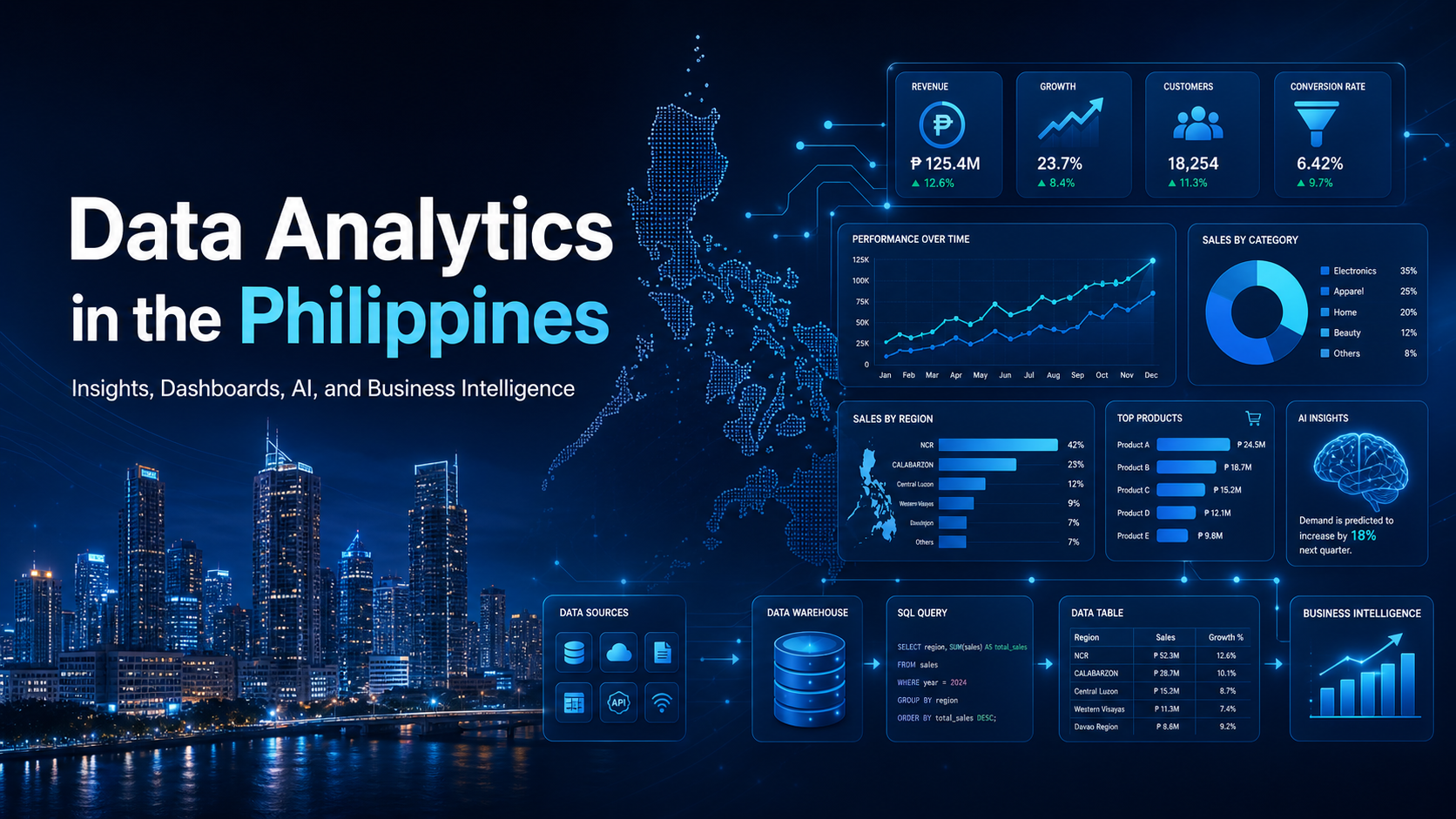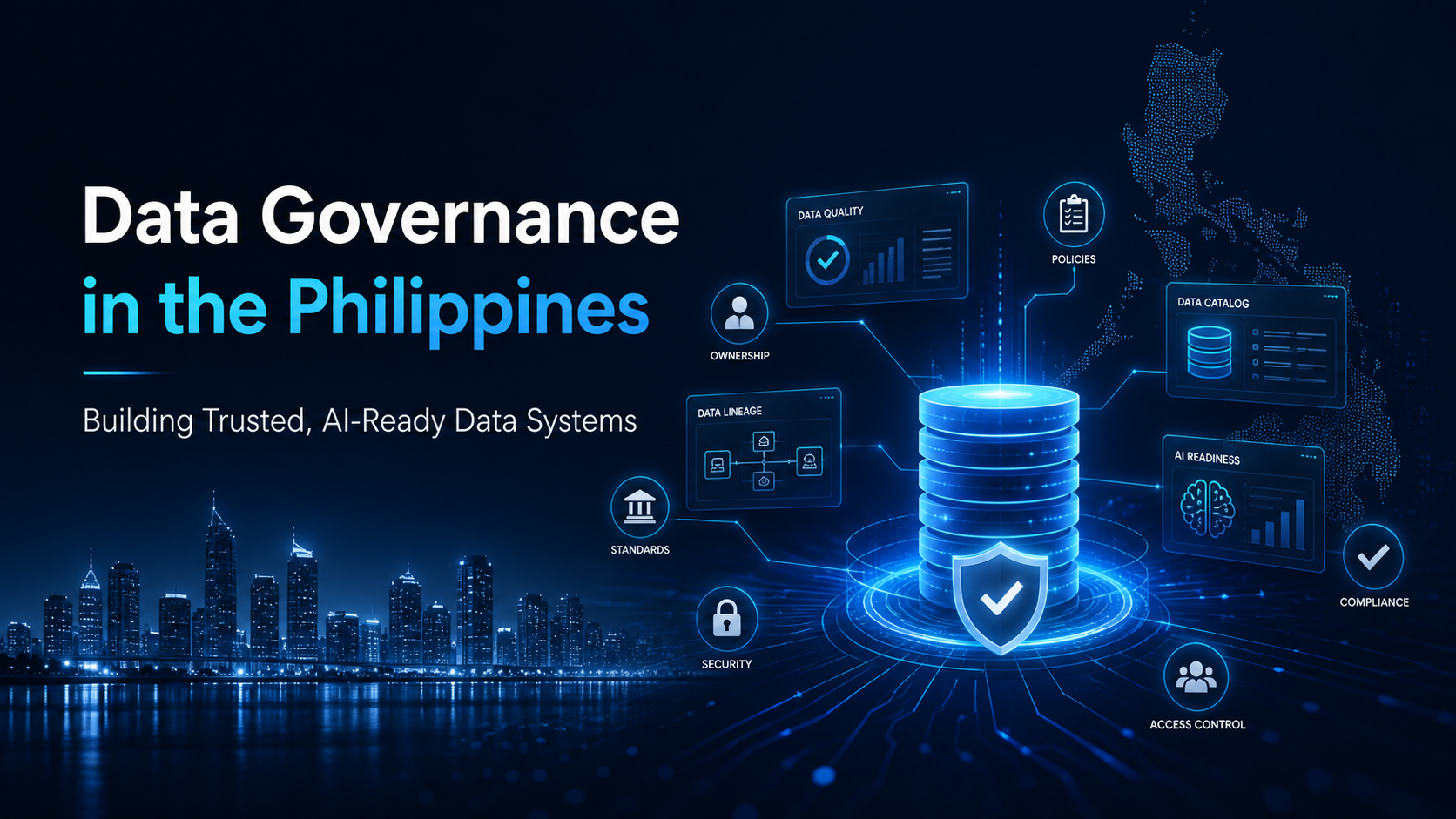
What a Data Governance Manager Does in the Philippines: Building Trusted, AI-Ready Data Systems
In the age of artificial intelligence, dashboards, automation, and digital transformation, one truth is becoming impossible to ignore:
AI is only as good as the data behind it.
Many companies in the Philippines are investing in business intelligence tools, dashboards, automation platforms, and AI-powered systems. But without trusted data, these tools often create more confusion than clarity.
This is where data governance becomes critical.
A Data Governance Manager helps organizations make sure that data is accurate, consistent, secure, well-defined, and ready to support better decisions. In simple terms, data governance turns messy business data into trusted business intelligence.
For Philippine organizations preparing for AI adoption, data governance is no longer optional. It is the foundation.
What Is Data Governance?
Data governance is the set of rules, roles, processes, and systems that help an organization manage data properly.
It answers important questions such as:
- Who owns the data?
- Who is responsible for fixing data issues?
- What does each data field mean?
- Which source of data should be trusted?
- How do we measure data quality?
- How do we protect sensitive information?
- How do we make data usable for analytics and AI?
Without data governance, different teams may use different definitions, reports may contradict each other, and leaders may lose confidence in the numbers they see.
With data governance, an organization can create a single, trusted foundation for reporting, analytics, automation, and AI.
What Does a Data Governance Manager Do?
A Data Governance Manager acts as the bridge between business teams, data teams, technology teams, and leadership.
The role is not only technical. It is also strategic, operational, and people-focused.
A Data Governance Manager typically works on:
1. Data Quality Management
Data quality is one of the most important parts of governance.
A Data Governance Manager helps define and monitor data quality rules such as:
- Completeness
- Accuracy
- Consistency
- Timeliness
- Validity
- Uniqueness
For example, if customer, product, financial, or operational data contains missing values, duplicate records, outdated definitions, or inconsistent formats, the business may make poor decisions.
Good data governance helps prevent that.
2. Data Stewardship
Data stewardship means assigning clear responsibility for data.
A Data Steward is usually a business or data representative who helps maintain the quality and meaning of specific data domains.
A Data Governance Manager helps organize the stewardship model by defining:
- Data owners
- Data stewards
- Data custodians
- Escalation paths
- Approval workflows
- Data issue resolution processes
This is important because data problems cannot be solved by IT alone. Business teams must also be involved because they understand the meaning and usage of the data.
3. Business Glossary and Data Definitions
One common problem in many organizations is that different teams define the same metric differently.
For example:
- What counts as an “active customer”?
- What is the official definition of “revenue”?
- What is the difference between “gross sales” and “net sales”?
- Which report is the official source of truth?
A business glossary helps solve this problem.
It creates shared definitions for key business terms, metrics, and data fields. This allows teams to communicate using the same language.
For analytics and AI, this is extremely important. If the organization cannot define its own data clearly, AI systems will also struggle to produce reliable outputs.
4. Governance Frameworks and Policies
A Data Governance Manager also helps create frameworks and policies that guide how data should be handled.
This may include:
- Data governance operating model
- Data quality framework
- Data access guidelines
- Data issue management process
- Data ownership structure
- Reporting standards
- Metadata management
- Data privacy and compliance alignment
The goal is not to create bureaucracy. The goal is to create clarity.
Good governance should make work easier, not slower.
5. Analytics and Decision Support
Data governance directly improves business intelligence.
When data is clean, trusted, and well-defined, reports and dashboards become more reliable.
This helps leaders answer questions such as:
- What is really happening in the business?
- Which process needs improvement?
- Which product, region, team, or channel is performing best?
- Where are the risks?
- Where are the opportunities?
For analytics teams, governance reduces confusion, rework, and reporting conflicts. Instead of constantly debating numbers, teams can focus on insights and action.
Why Data Governance Matters in the Philippines
The Philippines is experiencing rapid digital transformation across industries such as banking, insurance, retail, energy, healthcare, education, government, BPO, and technology.
Many organizations are adopting:
- Cloud platforms
- Business intelligence dashboards
- Automation tools
- AI assistants
- Customer data platforms
- Enterprise reporting systems
- Digital government services
But digital transformation without data governance creates risk.
Common problems include:
- Inconsistent reports across departments
- Manual spreadsheet-based processes
- Duplicate customer or transaction records
- Poor data ownership
- Lack of standard definitions
- Slow reporting cycles
- Low trust in dashboards
- Weak readiness for AI adoption
For Philippine companies, data governance is becoming a competitive advantage.
Organizations that manage their data well can make faster decisions, reduce operational risk, improve customer experience, and prepare for AI-driven transformation.
Data Governance and AI Readiness
AI has made data governance even more important.
Many organizations want to use generative AI, predictive analytics, machine learning, automation, and AI-powered decision systems. But these systems depend heavily on the quality and structure of data.
If the data is poor, AI may produce poor recommendations.
If definitions are unclear, AI may misunderstand business context.
If ownership is missing, no one knows who should fix problems.
If access rules are weak, sensitive data may be exposed.
This is why every organization preparing for AI should ask:
Is our data trusted enough to power intelligent systems?
AI readiness is not only about buying AI tools. It is about preparing the organization’s data foundation.
A strong AI-ready data governance framework includes:
- Clear data ownership
- Standard business definitions
- Strong data quality rules
- Secure access management
- Reliable reporting sources
- Metadata and lineage visibility
- Human accountability
- Continuous monitoring
The future of AI in business will belong to organizations that can govern their data well.
The Skills Needed by a Modern Data Governance Manager
A modern Data Governance Manager needs more than policy knowledge.
The role requires a combination of business, technical, analytical, and leadership skills.
Important skills include:
| Skill Area | Why It Matters |
|---|---|
| Data Quality | Ensures reports and analytics are reliable |
| Data Stewardship | Creates accountability across business teams |
| Business Intelligence | Connects governance to dashboards and decision-making |
| SQL and Data Analysis | Helps validate and investigate data issues |
| Communication | Aligns business, IT, and leadership stakeholders |
| Process Design | Turns governance into repeatable workflows |
| Change Management | Helps teams adopt better data practices |
| AI Awareness | Prepares data for automation, analytics, and AI systems |
The best data governance leaders are not only rule-makers. They are translators, problem-solvers, and transformation partners.
My Perspective as a Data Governance and Analytics Leader
As a Data Governance and Analytics Manager, I see data governance as one of the most practical foundations for digital transformation.
In enterprise environments, data problems are rarely just technical problems. They are often process, ownership, definition, and accountability problems.
A dashboard can only show the truth if the data behind it is properly governed.
An AI system can only produce useful output if the data foundation is reliable.
A business can only move fast if teams trust the numbers they are using.
This is why I believe data governance should not be treated as a back-office function. It should be seen as a strategic capability.
For organizations in the Philippines, especially those moving toward AI, automation, and advanced analytics, data governance is one of the most important investments they can make.
How Philippine Organizations Can Start with Data Governance
Organizations do not need to start with a perfect enterprise-wide framework. They can start small and mature over time.
Here is a practical starting point:
Step 1: Identify critical data domains
Start with the most important data areas, such as:
- Customer data
- Product data
- Sales data
- Financial data
- Supplier data
- Employee data
- Operational data
Focus on the data that directly affects decision-making.
Step 2: Define data owners and stewards
Assign clear accountability.
Every critical data domain should have people responsible for quality, definitions, usage, and issue resolution.
Without ownership, governance becomes theoretical.
Step 3: Create standard definitions
Build a simple business glossary.
Start with the most used business terms and metrics. Make sure teams agree on official definitions.
This reduces confusion and improves reporting trust.
Step 4: Measure data quality
Define data quality rules and track them regularly.
Examples:
- Required fields must not be blank
- Dates must follow a valid format
- Duplicate records must be flagged
- Codes must match approved reference lists
- Key fields must be updated within an expected timeframe
What gets measured can be improved.
Step 5: Build governance into reporting and analytics
Governance should not sit separately from analytics.
Data quality checks, definitions, and ownership should be connected to dashboards, reports, and decision-making processes.
This makes governance visible and valuable to the business.
Step 6: Prepare for AI governance
Once the data foundation becomes stronger, organizations can start preparing for AI governance.
This includes:
- Defining acceptable AI use cases
- Reviewing data privacy risks
- Validating AI outputs
- Monitoring bias and accuracy
- Ensuring human accountability
- Documenting data sources used by AI systems
AI governance starts with data governance.
Data Governance Is a Business Advantage
Data governance is not just about compliance.
It is about trust.
It helps organizations trust their reports, trust their dashboards, trust their automation, and eventually trust their AI systems.
For the Philippines, this is especially important as more businesses, schools, startups, government agencies, and enterprises accelerate digital transformation.
The organizations that win in the AI era will not simply be the ones with the most tools.
They will be the ones with the most trusted data.
Frequently Asked Questions
What is a Data Governance Manager?
A Data Governance Manager leads the processes, policies, roles, and frameworks that help an organization manage data properly. The role focuses on data quality, ownership, stewardship, definitions, compliance alignment, and trusted reporting.
Why is data governance important for AI?
AI systems depend on data. If the data is inaccurate, incomplete, inconsistent, or poorly defined, AI outputs can become unreliable. Strong data governance helps make data more trustworthy and AI-ready.
What is the difference between data governance and data analytics?
Data analytics focuses on analyzing data to generate insights. Data governance focuses on making sure the data used for analytics is accurate, consistent, secure, and properly defined. Governance improves the quality of analytics.
Is data governance only for large companies?
No. Large companies may need more formal governance structures, but small and medium businesses also benefit from clear data ownership, clean records, standard definitions, and reliable reporting.
How can Philippine companies start with data governance?
Philippine companies can start by identifying critical data, assigning data owners, creating standard definitions, measuring data quality, and connecting governance practices to dashboards and business decisions.
About John Cedrick “JC” de las Alas
John Cedrick “JC” de las Alas is a Data Governance and Analytics Manager, Software Engineer, Founder, CEO, AI and Tech Educator, and Digital Product Strategist based in the Philippines.
He works at the intersection of data governance, analytics, business intelligence, AI transformation, and digital innovation. His work focuses on helping organizations turn messy data into trusted, decision-ready systems.
JC is also the founder of AHA Innovations, Millennial Business Academy, and Millennial Business Innovations, where he helps professionals, entrepreneurs, and organizations adopt practical technology, automation, analytics, and AI-powered solutions.
If you are looking for a speaker, consultant, educator, or collaborator in data governance, analytics, AI transformation, or business intelligence, you can connect with JC through his official portfolio at jcdelasalas.org.