What a Data Analytics Manager Does in the Philippines: Turning Business Data Into Decisions
Data analytics is no longer just a technical function. In modern organizations, it has become one of the most important drivers of business decision-making.
In the Philippines, more companies are adopting dashboards, automation, cloud platforms, reporting tools, and AI-powered systems. But tools alone do not create value.
The real value comes from people who can translate raw data into business insight.
That is where a Data Analytics Manager comes in.
A Data Analytics Manager helps organizations turn scattered data into reports, dashboards, performance insights, and strategic recommendations that leaders can actually use.
What Is Data Analytics?
Data analytics is the process of collecting, cleaning, analyzing, and interpreting data to support better decisions.
It helps answer questions such as:
- What is happening in the business?
- Why is it happening?
- What should we improve?
- Where are the risks?
- Where are the opportunities?
- What actions should leaders take next?
Data analytics connects business questions with evidence.
Instead of relying only on opinion, organizations can use data to guide decisions.
What Does a Data Analytics Manager Do?
A Data Analytics Manager leads analytics initiatives across teams, systems, and business functions.
The role usually combines technical skills, business understanding, stakeholder management, and leadership.
A Data Analytics Manager typically works on:
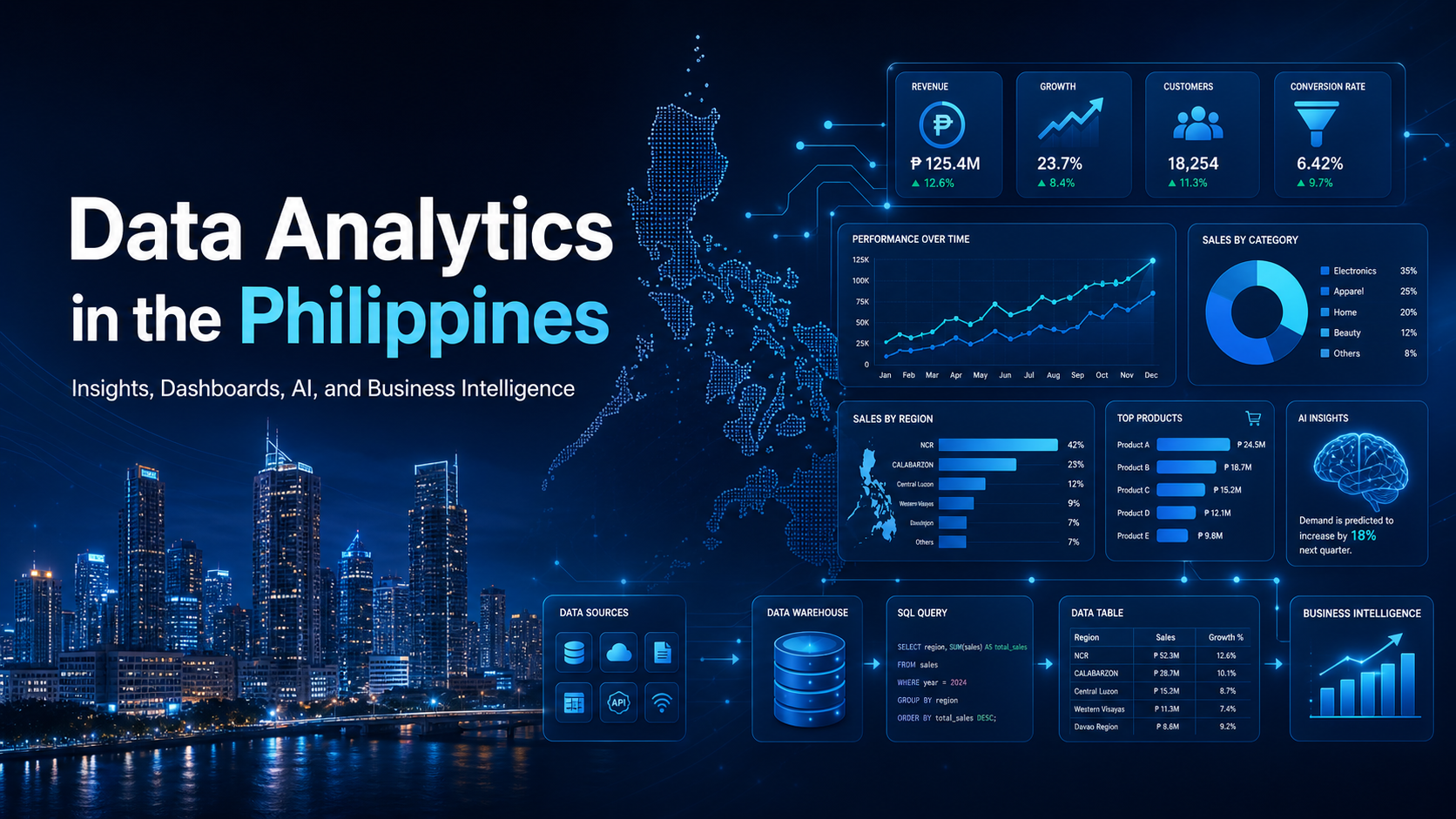
- Business intelligence dashboards
- SQL reports
- Data quality checks
- KPI definitions
- Performance analysis
- Reporting automation
- Stakeholder alignment
- Data storytelling
- Analytics team management
The job is not only about creating charts. It is about helping people understand what the numbers mean.
Why Data Analytics Matters in the Philippines
Many Philippine organizations still rely heavily on spreadsheets, manual reporting, and fragmented data sources.
This creates problems such as:
- Slow reporting cycles
- Conflicting numbers across departments
- Manual errors
- Low trust in dashboards
- Limited visibility into business performance
- Delayed decisions
Data analytics helps solve these problems by creating a clearer view of the business.
For companies in banking, BPO, retail, energy, healthcare, education, government, and technology, analytics can improve efficiency, reduce risk, and support growth.
Data Analytics vs Business Intelligence
Data analytics and business intelligence are closely related, but they are not exactly the same.
Business intelligence usually focuses on dashboards, reports, KPIs, and performance monitoring.
Data analytics goes deeper by asking why something happened and what should be done next.
A good analytics function should include both.
Business intelligence shows what is happening.
Data analytics explains what it means.
Key Skills of a Data Analytics Manager
A modern Data Analytics Manager needs a combination of technical and leadership skills.
| Skill | Why It Matters |
|---|---|
| SQL | Helps retrieve, validate, and analyze data |
| Dashboarding | Turns raw data into visual insights |
| Data Storytelling | Helps stakeholders understand insights |
| Business Acumen | Connects data to real business decisions |
| Data Quality | Ensures reports are accurate and trusted |
| Stakeholder Management | Aligns analytics with business needs |
| Leadership | Guides analysts, stewards, and reporting teams |
| AI Awareness | Prepares analytics teams for AI-assisted decision-making |
The best analytics managers are not just tool users. They are business translators.
How Data Analytics Supports Better Decisions
Data analytics can help organizations answer practical business questions.
For example:
- Which process creates the most delays?
- Which product or service performs best?
- Which customer segment is most profitable?
- Which team needs support?
- Which region is underperforming?
- Which activity creates the highest return?
These insights help leaders move from assumption-based decisions to evidence-based decisions.
The Future of Data Analytics in the Philippines
The future of data analytics will be strongly connected to AI.
As AI tools become more common, analytics professionals will need to focus on higher-value work such as:
- Asking better business questions
- Validating AI-generated insights
- Improving data quality
- Designing better dashboards
- Explaining insights to decision-makers
- Building trusted data foundations
AI will not remove the need for analytics leaders. It will increase the need for people who can combine analytics, governance, and business judgment.
About John Cedrick “JC” de las Alas
John Cedrick “JC” de las Alas is a Data Governance and Analytics Manager, Software Engineer, Founder, CEO, AI and Tech Educator, and Digital Product Strategist based in the Philippines.
He works at the intersection of data analytics, business intelligence, data governance, AI transformation, and digital innovation.
Through his professional work, teaching, and ventures, JC helps organizations and professionals turn data, technology, and AI into practical business value.